Launching a successful skincare line begins with the most fundamental step of any daily routine: the cleanser. For beauty brands looking to scale rapidly without heavy capital investments in factories, facial cleanser OEM (Original Equipment Manufacturer) services offer a highly efficient path to market.
This guide breaks down the science, formulations, and manufacturing steps behind facial cleanser contract manufacturing, designed to help brands navigate the OEM landscape and secure high-quality, compliant formulations.
1. The Science of Cleansing: How Modern Formulations Work
To build a high-performance facial cleanser, brands must understand the underlying science. Cleansers remove dirt, excess sebum, pollutants, and makeup using surfactants (surface-active agents).
Surfactants are amphiphilic molecules, meaning they possess both a hydrophilic (water-attracting) head and a lipophilic (oil-attracting) tail. When mixed with water on the skin, these molecules self-assemble into spherical structures called micelles.
- The Cleansing Action: The lipophilic tails point inward to trap oil-soluble dirt and sebum, while the hydrophilic heads point outward toward the water.
- The Rinse-Off: As the user rinses with water, the micelle structures—carrying the trapped oils and debris—are washed away, leaving the skin clean.
During the facial cleanser OEM briefing, brands must decide how aggressive this cleansing action should be. Over-cleansing strips the stratum corneum (the skin’s outermost barrier) of essential lipids like ceramides and cholesterol, leading to trans-epidermal water loss (TEWL) and irritation. Modern consumers overwhelmingly prefer mild formulations that cleanse without disrupting this delicate barrier.
2. Core Surfactant Systems in OEM Manufacturing
The choice of surfactant defines your cleanser’s market positioning, texture, cost, and target skin type. When partnering with an OEM factory, you will generally choose between four primary surfactant technologies:
| Surfactant System | Key Chemical Ingredients | Pros | Cons | Target Market Segment |
| Amino Acid-Based | Sodium Cocoyl Glycinate, Sodium Lauroyl Glutamate, Potassium Cocoyl Glycinate | Exceptionally gentle, maintains skin’s natural acidic pH, high consumer demand | Higher raw material cost, harder to thicken naturally | Premium skincare, dry, sensitive, or compromised skin |
| Soap-Based | Fatty acids (Lauric, Myristic, Palmitic, Stearic) + neutralizing base (Potassium Hydroxide) | Rich, dense, cushioning foam; excellent degreasing; cost-effective | High pH (typically 9.0 to 10.0), can strip skin lipids | Oily skin, heavy-duty deep cleansing, traditional Asian markets |
| APG (Alkyl Polyglucoside) | Coco-Glucoside, Decyl Glucoside, Lauryl Glucoside | Biodegradable, plant-derived, very low irritation potential | Distinct raw material scent, can feel slightly tacky if poorly formulated | Eco-conscious brands, clean beauty, baby care |
| Sulfate-Based | Sodium Laureth Sulfate (SLES), Ammonium Lauryl Sulfate (ALS) | High foaming capacity, excellent viscosity control, very low cost | High irritation potential, heavily stigmatized by modern consumers | Mass-market, budget-friendly body washes or basic cleansers |
3. Active Ingredients & pH Engineering
Beyond the surfactant base, a competitive facial cleanser formulation requires a carefully engineered pH and strategic active ingredients.
The pH 5.5 Trend
Healthy human skin has a slightly acidic natural pH, typically ranging between 4.5 and 5.75. Traditional soap-based cleansers disrupt this “acid mantle,” raising the skin’s pH and making it vulnerable to pathogens like Cutibacterium acnes.
By utilizing amino acid or APG surfactants, OEM manufacturers can formulate weak-acid cleansers (pH 5.5 to 6.0) that protect the skin barrier while maintaining optimal enzymatic activity within the stratum corneum.
Actives Integration in Rinse-Off Products
Because cleansers are on the skin for less than 60 seconds, integrating active ingredients requires specific formulation strategies to ensure efficacy:
- Exfoliating Acids (AHAs/BHAs): Salicylic Acid (BHA) is oil-soluble, making it highly effective in cleansers for acne-prone skin because it can penetrate and clear sebum-clogged pores even in a short contact window.
- Humectants (Glycerin, Hyaluronic Acid): These help bind water to the skin during the washing process, mitigating any mild drying effects from the surfactants.
- Soothing Agents (Allantoin, Centella Asiatica, Panthenol): These additives reduce potential irritation and leave the skin feeling calm post-wash.
4. The Step-by-Step Facial Cleanser OEM Process
Bringing a custom facial cleanser from concept to mass production requires a structured timeline to guarantee stability, safety, and regulatory compliance.
1.Product Briefing & Target Positioning:Phase 1: 1-2 Weeks。
The brand outlines the target audience, preferred active ingredients, desired texture (gel, foam, cream, powder, or clay), packaging preferences, and target per-unit cost.
2.R&D Formulation & Sampling:Phase 2: 2-4 Weeks。
The OEM factory’s formulation chemists develop initial lab samples. The brand tests these prototypes for texture, foam density, rinseability, scent, and post-wash skin feel. Adjustments are made until the formulation is approved.
3.Stability & Packaging Compatibility Testing:Phase 3: 4-8 Weeks。
The finalized formula undergoes rigorous stability testing, including freeze-thaw cycles, high-temperature ovens (45°C to 48°C), and packaging compatibility tests to ensure the product does not separate, discolor, or react with the container.
4.Regulatory & Safety Clearance:Phase 4: 2-4 Weeks。
The formulation is submitted for required safety testing. The OEM factory assists in compiling the Product Information File (PIF) and securing filings with relevant bodies (such as FDA, EU CPNP, or China’s NMPA).
5.Mass Production, Filling, & QC:Phase 5: 3-5 Weeks。
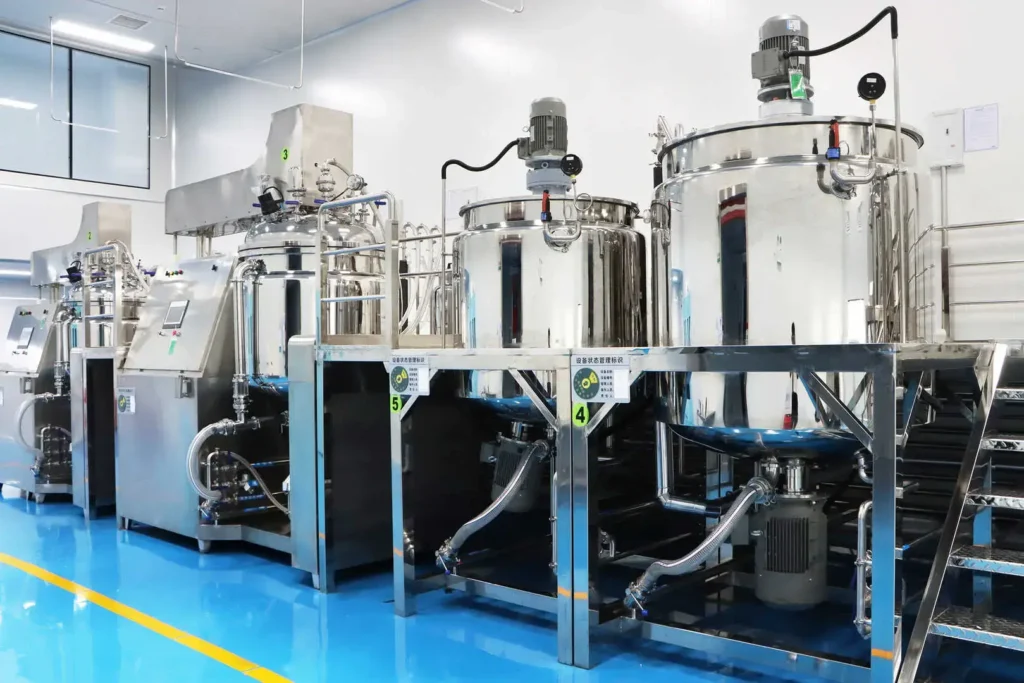
Raw materials are compounded in large vacuum emulsification mixers. The bulk product is then transferred to automated filling lines inside ISO-certified cleanrooms, where tubes, bottles, or jars are filled, sealed, batch-coded, and packaged.
5. Quality Standards & Certifications to Verify
When choosing a facial cleanser OEM partner, compliance is non-negotiable. Leading manufacturers should hold the following certifications:
- ISO 22716: The international standard for Cosmetics Good Manufacturing Practices (GMP). It covers production, control, storage, and shipment protocols.
- GMPC (US/Europe): Standardized guidelines ensuring cleanroom air filtration, sterile water systems, and rigorous sanitation of batching equipment.
- Microbiological Testing: Every production batch must undergo testing to ensure zero contamination from harmful pathogens such as Pseudomonas aeruginosa, Staphylococcus aureus, and Candida albicans.
6. Sourcing the Right OEM Partner: Key Considerations
For brand owners, picking the right manufacturer is a balance of capability, capacity, and cost. Keep these factors in mind:
- Minimum Order Quantity (MOQ): Startups should seek factories offering lower MOQs (e.g., 3,000 to 5,000 units) to minimize initial inventory risk, while established brands may leverage high-capacity plants (MOQs of 10,000+ units) to drive down unit costs.
- Turnkey (One-Stop) Services: Decide whether you need standard OEM (you supply packaging, they fill the liquid) or a full-service turnkey solution where the factory manages raw material sourcing, packaging design, custom printing, formulation, and shipping logistics.
- Specialization: Ensure the factory has a proven track record of formulating stable, high-performance facial cleansers, as the viscosity control of amino acid cleansers requires specialized manufacturing expertise compared to basic creams or lotions.