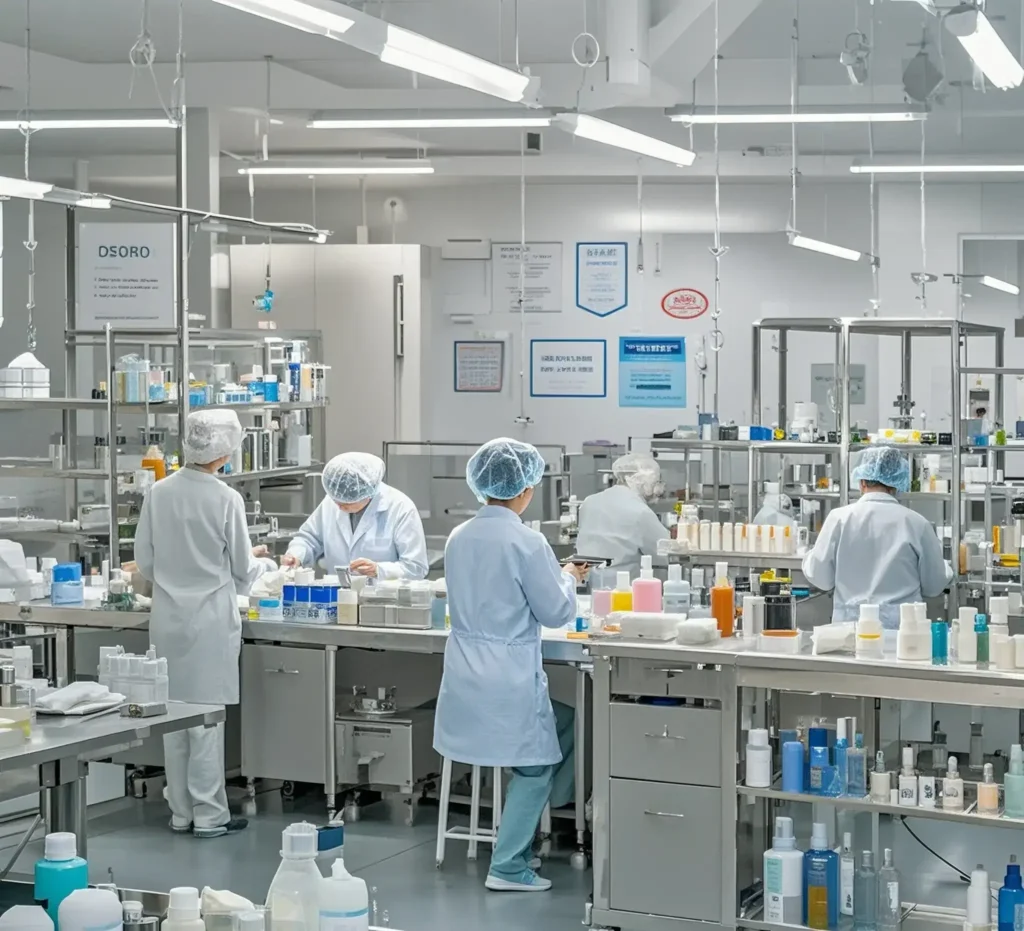
But choosing the wrong path can drain your budget, delay your launch, or leave you with a product that cannot legally be sold in your target market.
To help you navigate this high-stakes decision, let’s dive deep into how each model operates, the pros and cons, and the critical factors that will dictate which path is right for your skincare venture.
1. Private Label: The Turnkey Solution
Under a private label model, you choose from a library of pre-formulated, pre-tested products developed by the manufacturer. You cannot tweak the ingredients or the active concentrations, but you have complete control over the branding, the label design, and occasionally the container or outer packaging.
[Manufacturer's Stock Formula] ➔ [Your Custom Label & Box] ➔ [Market-Ready Product]
The Pros
- Minimal Upfront Costs: You bypass the expensive formulation phase, which can easily cost $3,000 to $10,000+ per product in chemist fees.
- Ultra-Fast Time-to-Market: Because the formula is already stable and safety-tested, you can launch a product line in as little as 4 to 8 weeks.
- Low Minimum Order Quantities (MOQs): Private label manufacturers often allow order sizes as low as 50 to 500 units, significantly lowering the barrier to entry.
The Cons
- Zero Product Differentiation: Your competitors can buy the exact same formulation. If your “Hydrating Peptide Serum” has identical ingredients to three other brands on Amazon, your only competitive edge is marketing.
- No Intellectual Property (IP): You do not own the formula. If your manufacturer goes out of business or spikes their pricing, you cannot take that recipe to another factory.
Best For:
Social media influencers, day spas, dermatologists, or bootstrapping startups looking to validate a brand concept before investing heavily in custom R&D.
2. OEM (Original Equipment Manufacturer): The Contract Manufacturer
In the skincare industry, an OEM partner acts strictly as your factory. You bring them the exact “recipe” (the formulation, ingredient specifications, and step-by-step compounding instructions), and they use their industrial-scale machinery to blend, fill, pack, and ship the product.
[Your Proprietary Formula] ➔ [OEM Factory Mixing & Packaging] ➔ [Your Unique Product]
The Pros
- Complete IP Ownership: You own the formula outright. If you ever need to switch manufacturers, you can pack up your recipe and take it to any other OEM on earth.
- Absolute Customization: You control every single ingredient, active concentration, texture, scent, and color. This allows you to build a true, defensible “brand moat.”
- Cost Efficiency at Scale: When ordering in massive volumes, OEM manufacturing offers the lowest cost-per-unit (COGS).
The Cons
- Expensive and Slow: Developing a custom formula from scratch requires hiring a cosmetic chemist, sourcing raw ingredients, and conducting rigorous stability and preservative efficacy testing (which takes 3 to 6 months minimum).
- High MOQs: OEM factories rarely start production for less than 5,000 to 10,000 units per Stock Keeping Unit (SKU) because cleaning and calibrating industrial mixing tanks for smaller runs is not cost-effective.
Best For:
Established skincare brands scaling their operations, clean-beauty brands with highly specific ingredient bans, or founders with patented, proprietary cosmetic technology.
3. ODM (Original Design Manufacturer): The Concept-to-Shelf Partner
ODM is a hybrid approach. You approach a manufacturer with a concept or a target performance goal (e.g., “I want a lightweight, purple-tinted night cream that uses bakuchiol and targets hyperpigmentation”). The ODM’s in-house research and development (R&D) team then formulates, tests, and refines the product to meet your specifications.
[Your Idea & Concept] ➔ [ODM In-House R&D & Formulation] ➔ [Fully Customized Finished Product]
The Pros
- Custom Formulations Without Chemist Fees: You get a custom-tailored product without having to source your own cosmetic chemist or handle the complex science of emulsification and preservation.
- Turnkey Convenience: ODMs typically handle everything from raw material sourcing and regulatory compliance testing to packaging procurement.
- Moderate MOQs: ODMs generally require lower MOQs than strict OEMs—typically ranging from 1,000 to 3,000 units.
The Cons
- IP Gray Areas: Who owns the final formula? In many ODM contracts, the manufacturer retains the formulation rights. If you want to move production to a different factory, you may have to pay a hefty “formula buyout fee” (ranging from $5,000 to $20,000+).
- Longer Timelines than Private Label: Because you are developing a custom formula, you still have to wait for formulation iterations and stability testing. Expect a launch timeline of 6 to 12 months.
Best For:
Fast-growing brands looking to differentiate themselves with unique formulas, but who lack the internal scientific expertise or raw material supply networks to manage the formulation process independently.
Side-by-Side Comparison
To help you see how these models compare across key operational metrics, review the breakdown below:
| Metric | Private Label | OEM | ODM |
| Formulation Source | Manufacturer’s existing catalog | Brand owner’s proprietary recipe | Co-developed with manufacturer |
| IP Ownership | Manufacturer | Brand Owner | Usually Manufacturer (unless bought out) |
| Average MOQs | 50 – 500 units | 5,000 – 10,000+ units | 1,000 – 5,000 units |
| Development Cost | $(Low) \vert{}$$$(High R&D & testing) \vert{}$$ (Moderate) | ||
| Time to Market | 1 – 2 months | 9 – 18 months | 6 – 12 months |
| Product Uniqueness | Low (Off-the-shelf) | High (Fully custom) | High (Custom built for you) |
Making Your Decision: The 3 Crucial Questions
If you are still on the fence about which manufacturing route to choose, answer these three questions to clarify your path:
1. What is your total startup budget?
If your total starting capital is under $10,000, Private Label is your only viable path. If you have $10,000 to $30,000, you can comfortably explore ODM partnerships for a small, specialized line. If your budget exceeds $50,000, you have the financial runway to pursue OEM and own your formulas outright.
2. How unique does the product actually need to be?
Does your brand’s value proposition rely on a highly specific, revolutionary active ingredient? If yes, you must use OEM or ODM. However, if your brand’s magic lies in its community, storytelling, or aesthetic packaging, a high-quality Private Label formula will save you time and money while allowing you to focus on marketing.
3. What is your long-term exit strategy?
If you plan to eventually sell your skincare company to a major conglomerate (like Estée Lauder, L’Oréal, or Unilever), those buyers are purchasing your intellectual property. Acquiring a brand that does not own its formulas is incredibly risky for them. If acquisition is your end game, prioritizing OEM or negotiating formula buyouts with an ODM is a non-negotiable step.
Whichever route you choose, ensure you vet your manufacturing partner thoroughly. Ask for their certifications (such as ISO 22716 or cGMP compliance), request physical samples of both the formulas and packaging options, and always have a legal professional review your intellectual property clauses before signing on the dotted line.